Related Posts Plugin for WordPress, Blogger...

Conference: The Beating Heart of London’s Business

Wednesday, 23 January 2013

The Beating Heart of London’s Business: Exploring Company Archives Their Uses and Users

On the 12th and 13th April 2013 a two-day conference, organised by The Archives and Artefacts Study Network (A2SN) and supported by the Postal History Society, the Business Archives Council and the Historical Model Railway Society will take place in London.

This is the second such conference following last year's event in Derby and both seek to explore and expand co-operation between volunteer-led societies involved in business history fields and the academics, archivists and museum professionals working in the same areas. The events aim to prompt an awareness of what these various groups are doing, and to start a dialogue between the enthusiast and academic which may lead to co-operation in preserving and using collections, and furthering our understanding of the past and its relevance to the future.

London, as a venue for the second conference, has been facilitated by John Scott, Chairman of the Culture, Heritage & Libraries Committee of the City of London Corporation, who is one of our speakers. The event is hosted by London Metropolitan Archives and Museum of London Docklands and themes of trade and commerce are drawn from holdings in their care. London is a world-renowned centre for business, a place where the means of communication, written, electronic and physical, come together. It is not surprising therefore to find a vast array of business archives held in archival repositories in and around the City. Whatever your passion, we aim to give you new opportunities, avenues of exploration and fresh insights.

To find out more please download the flyer with a booking form.  Proceedings of last year’s event are also available to download.

Read more...

Businesses at Christmas

Monday, 24 December 2012

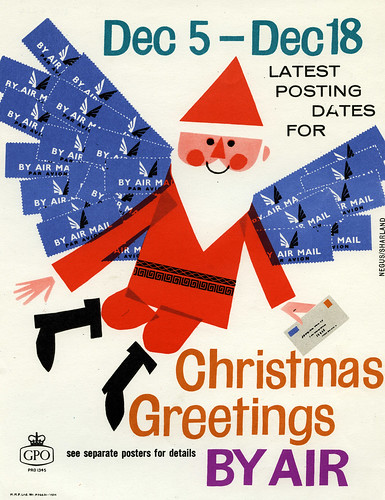
Christmas greetings by air
[from BPMA Flickr here]
Before finishing up for Christmas, I wanted to share some of the lovely bits and bobs that business archive collections have been sharing in the last couple of weeks.

The Christmas posters from British Postal Museum and Archive are as always great, including this example above. They also have a series of podcasts, that include one on the history of Christmas cards.

The Design Archives at the University of Brighton exists to promote the study of design and is an internationally significant scholarly resource focusing on British design and global design organisations in the 20th century. They have a set up on Flickr - Season's Greetings from the Design Archives.

The National Railway Museum has been sharing images on twitter, including this one of GNR Christmas Excursions. As has M&S Heritage, the Guardian Archive and Coca-Cola Archives. The Royal Bank of Scotland Group Archives have been doing the same thing over on their facebook.


Read more...

Case Study: Dundee Whaling Project

Friday, 21 December 2012

We've squeezed in another new case study on the Scottish Business Archives website before the end of the year. This is a really interesting one about how archives, museums and libraries with collections relating to Dundee's whaling history have worked together to produce a resource that highlights the fantastic history of the industry.


The full case study is available here and there others can be found here.

We've a few more drafted and ready to go in the New Year, so keep an eye out for them.

Read more...

Instruments of Power

Wednesday, 19 December 2012

Instruments of Power is a follow-on project by Paul Sillitoe from his PhD research at the University of Liverpool. The aim of that research was to develop new ways to make technical drawings more accessible for researchers, by making them more understandable for archivists.

Download a pdf of this image

The text below has been submitted by Paul, his new project will work with archivists and researchers to transform theoretical findings into practical outcomes. So he will be looking for archivists and researchers to act as consultees for the project.

The Problem
Technical drawings graphically represent engineering and manufacturing designs better than any textual description. These potent instruments of power and innovative thought depict progress, process and product across British industry.

Yet they are under-valued, under-used and at-risk research resources - less likely than textual records to be selected as archives, or adequately described for researchers. Why?

As a second-career archivist, from an engineering background, I took reading technical drawings for granted. Yet as I began to manage archival cataloguing teams, I realised that many archivists could not understand them. Their predominantly arts-based backgrounds had not equipped them for this foreign technical language, whose graphical conventions differed across industries and time.

Consequently, many technical drawings, even if secured for archival preservation, remain uncatalogued and inaccessible to researchers. The archival record for Britain’s period of industrialisation is therefore unbalanced.

A Research Solution
My hypothesis is that archivists do not need to understand a technical drawing in its entirety. They only need to be able to extract the information required for appraisal and cataloguing.

The aim of the PhD research was therefore to discover whether sufficient information could always be found within a technical drawing that was unrelated to its subject content. Such generic information, if identified and described, could form the basis for practical guidance to the understanding of technical drawings.

The PhD research statistically surveyed a sample of complex twentieth-century technical drawings. Individual concepts and characteristics were identified, and their frequencies of occurrence quantified. Thirty four concepts and characteristics were identified as almost always occurring within technical drawings, and having potential to be useful to understanding.

Forty further concepts and characteristics were identified as occurring less frequently within the sample. They have potential to be useful to understanding if they are found to occur more frequently in other samples of technical drawings. Archivist and researcher consultees are now required. Consultees are now sought to help assess the practical utility of these concepts and characteristics in understanding technical drawings. The consultation will be held principally online. Your views will contribute to published practical guidance to the understanding of technical drawings for archivists and researchers.

If you are interested in the project, then please contact Paul on paul@sillitoe-uk.net

Read more...

Scotland's Industrial Souvenir

Friday, 14 December 2012

The Royal Commission on the Ancient and Historical Monuments of Scotland have digitised volume 2 of their copy of Scotland's Industrial Souvenir. This is a trade catalogue from 1905 which highlights Scotland's industrial achievements. RCAHMS head of collections Lesley Ferguson, said:
“From Edinburgh’s breweries, brush makers, glue factories and ironmongers, to fish merchants in Aberdeen and confectioners and jute merchants in Dundee, these beautifully detailed advertisements conjure up the sights, sounds and smells of Scotland’s industrial heyday."
The BBC produced a lovely gallery of the images on their site yesterday, which is the second time they've include business archives on the site following the gallery of Bartholomew Archive last week.

Read more...

About This Blog

This blog will provide information about the development of a National Strategy for Business Archives in Scotland. It will also be used to provide general updates about Business Archives in Scotland.

This blog is written by Kiara King, the Ballast Trust archivist. Updates on the Data Mapping Project are written by Cheryl Brown, project officer.
This blog ceased to be updated in 2013. Follow @busarchscot for the latest news on business archives in Scotland.

Participate

The Business Archives Strategy for Scotland was published in August, read it here. Keep an eye on the blog for more news about business archives and the strategy's implementation.

You can also contact us at any time with thoughts and contribute your comments to the blog!

Contact us

Please contact us if you have any comments or suggestions.

Kiara King (Ballast Trust Archivist)
Kiara.King@glasgow.ac.uk

BACS
bacs@archives.gla.ac.uk